
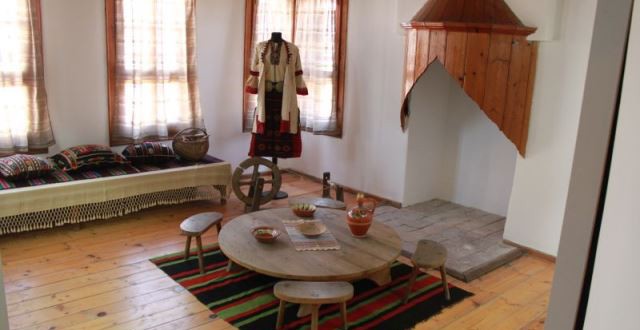
The exhibition presents, albeit partially, the rich artistry of the Bulgarian woman from the Strandzha region, as well as from the plains of Karnobat and Aytos, and last but not least, from the Black Sea coast.
The Moskoiani House is one of the Revival-era architectural monuments. Its design is typical of Nessebar’s residential architecture from the end of the Bulgarian National Revival.
The ground floor of the two-story house is built of stone and features a high ceiling and double-winged door. The upper floor, used as a living space, is clad in wooden boards. This floor has numerous tall windows offering views of the sea. The five rooms are arranged around a central salon, whose wooden ceiling is adorned with a carved star-shaped rosette. The northern rooms, used during winter, are equipped with fireplaces.
The museum hosts an ethnographic exhibition titled “Traditional Costumes and Textiles from the Burgas Region.” This region is one of the richest in terms of traditional weaving and folk costumes, developed over the centuries.